10 Years. 10 Million Students. One Mission.
Pakistan faces the world's second-largest out-of-school crisis — 26 million children not in school, and 80% of those in school unable to read at grade level. Teachers receive training once every 13 years.
From a classroom in Islamabad to 6 countries across 3 continents. This is the story of how evidence-driven education technology is transforming learning for the world's most underserved children.
Teachers Supported
Countries
Schools Served
Years of Impact
Independent Recognition
As Featured In
Digital transformation case study in UNESCO's financing toolkit for education systems.
Independent evaluation of teachers co-designing WhatsApp AI tools in Pakistan.
Selected as a solution for global learning challenges by MIT.
Coverage of digital education impact on student learning in Pakistan.
Portfolio company profiled for reach and learning outcomes.
Technical case study on AI development for classroom integration.
Chapter 02
Theory of Change
Five Things Must Go Right for Students to Learn More
The Causal Chain
If any link breaks, everything downstream fails
We track every link — not just the last one.
Access
Are teachers engaging with the support?
Practice
Are lesson plans improving teaching?
Coaching
Are coaching cycles completing?
Sustained Change
Is quality improving over time?
Student Learning
Are students learning more?
Each link depends on the one before it. Click any stage to see the logic.
The Mechanism
Loop Closure
The hardest metric to game. Five steps that ensure feedback leads to real practice change.
Loop
Closure
Record
Lesson audio uploaded
Analyze
AI provides specific feedback
Commit
Teacher picks a concrete action
Teach
Next lesson recorded
Verify
AI checks: did practice change?
Record
Lesson audio uploaded
Analyze
AI provides specific feedback
Commit
Teacher picks a concrete action
Teach
Next lesson recorded
Verify
AI checks: did practice change?
Yes → Next skill
No → Human coach
AI handles frequency (every lesson, 24/7). Humans handle complexity (relationships, judgment).
Chapter 03
Low-Cost Private Schools
Where It All Began
0.46
SD Effect Size
Taleemabad started in low-cost private schools — proving that technology-enhanced teaching works in the most resource-constrained environments. The results were unmistakable.
Across 150 schools and nearly 3,000 teachers studied, teacher certification delivered a medium-to-large effect size at a fraction of the cost of traditional coaching interventions. This evidence became the foundation for everything that followed.
Schools
Teachers Studied
0.46
SD Effect Size
$50-100
Per Teacher
Key Finding
In two years, Taleemabad students learned nearly three years' worth of Urdu — and two and a half years' worth of English.
Across 66 private schools, children in Taleemabad schools gained almost an entire extra year of Urdu learning and over half an extra year of English compared to similar students — Math showed no significant impact, a gap we're actively working to close.
Urdu: +0.50 SD (0.92 LAYS) | English: +0.35 SD (0.69 LAYS) | Math: not significant
Cost-Effectiveness Comparison
How teacher certification stacks up against other interventions
Teacher Certification
$50-100 per teacher
Typical Workshops
$100-300 per teacher
Instructional Coaching
$2,000-5,000 per teacher
Class Size Reduction
$5,000-10,000 per teacher
Effect size measured in standard deviations (Cohen's d)
Chapter 04
Taleemabad Enters Public Schools
Gold-Standard Evidence from Islamabad
0.8
Learning Adjusted Years
The Flagship Study
When Technology Meets Public Education
In September 2024, Taleemabad entered Islamabad's 422 public schools under the Federal Directorate of Education. This was not a small pilot or a friendly private-school partnership. This was an entire capital territory, with all its bureaucracy, under-resourced classrooms, and over-burdened teachers, agreeing to try something different.
The result was the NIETE Cluster Randomized Controlled Trial — the most rigorous evaluation of Taleemabad's model to date. Conducted in partnership with CERP and validated by World Bank methodology, it measured what happens when structured lesson plans, continuous AI coaching, and real-time feedback loops reach teachers at scale.
The answer was striking: 1.5 additional years of learning gains, equivalent to 0.8 Learning Adjusted Years of Schooling (LAYS). In Urdu alone, the percentage of students reading at grade level jumped from 35% to 56%.
422
Public Schools
4,000
Teachers Trained
90,000
Students
+21pp
Urdu Gains
0.28 SD
NIETE Cluster RCT (ASER 2024-25)
1.5 additional years of learning gains in foundational literacy and numeracy. Treatment students showed +21pp in Urdu, +16pp in Math, and +4pp in English over control schools.
Learning Outcomes by Subject
Treatment vs control comparison across all three subjects tested in the ASER instrument. The gains are concentrated in Urdu and Math, where Taleemabad's structured lesson plans are most developed.
Learning Outcomes: Treatment vs Control
Percentage of students meeting grade-level standards
Learning Gains Hotspots
Pinpointing Success in Islamabad
Percentage Point Increase in 'On-Target' Students (Endline vs. Baseline)
2024-2025| Grade | English | Urdu | Math |
|---|---|---|---|
| Grade 5 | +10.3 | +27.7 | +27.4 |
| Grade 4 | +14.7 | +25.3 | +17.2 |
| Grade 3 | -3.9 | +28 | +3.5 |
| Grade 2 | +1.8 | +14.7 | +13.8 |
| Grade 1 | -6.1 | -0.7 | -0.9 |
Learning Gain Scale (Percentage Points)
Top Performance: Grade 3 Urdu (+28), Grade 5 Math (+27.4), Grade 5 Urdu (+27.7)
Where This Happened
Every pin represents a Federal Directorate of Education school in Islamabad where Taleemabad's model was deployed. These are not hand-picked pilot schools — they represent the entire public school system of a capital territory.
Parhai On Call
For students without smartphones or internet access, we deployed a toll-free phone-based personalized tutoring system across ICT public schools. Students received one-on-one tutoring sessions over the phone, reaching 50,000+ calls during the programme.
50K+
Calls Received
Toll-Free
No Cost to Families
Grades 1–5
Curriculum-Aligned
Inspired by Youth Impact's ConnectEd programme — phone-based tutoring tested across Botswana, India, Kenya, Nepal, Uganda, and the Philippines, achieving 0.89 SD gains per $100 spent. Parhai On Call adapted this model for Pakistan's public school context.
Primary Evidence Base
Five reports documenting the ICT programme, from the gold-standard RCT to independent external evaluations.
Chapter 05
Balochistan
Into the Hardest-to-Reach Province
800
Teachers Trained
Uncharted Territory
Going Where Others Won't
Balochistan is Pakistan's largest and most sparsely populated province. With 2.6 million children out of school and a female literacy rate of just 15%, it represents the starkest frontier of the country's education crisis. Most programmes never make it here. The roads are long, the infrastructure is fragile, and the classrooms have almost never been formally observed.
In October 2024, Taleemabad entered Balochistan — not with a pilot, but with a research mandate. Two studies, conducted in rapid succession, aimed to answer a deceptively simple question: What actually happens inside a Balochistan classroom when nobody is watching?
60
Schools
8,000
Students
800
Teachers
522
AI Observations
Teacher Enablement Study
Conducted in partnership with DIME (Development Impact Evaluation) and the World Bank, this 4-arm RCT measured treatment effects on 1,230 students and 104 teachers across grades 2–3 in Balochistan. The results are now in — and they show that the model works even in Pakistan's most challenging province.
Student Learning Outcomes
(n=1,230)+0.23 SD
Urdu Read Sentence*
+0.11 SD
Math Word Problem**
+0.13 SD
Name Shapes**
Teacher Classroom Practice
(n=104)All 9 observation dimensions showed positive treatment effects, with the strongest gains in:
+0.34 SD*
Positive Behavioural Expectations
+0.32 SD*
Social & Collaborative Skills
Standard errors clustered at school level. Controls for baseline scores and enumerator/observer FE. *** p<0.01, ** p<0.05, * p<0.1
Winter School Programme
With 60 schools, 8,000 students, and 800 teachers, the Winter School Programme deployed Taleemabad's full stack: structured lesson plans, AI-powered classroom observation via Rumi, and targeted human coaching based on AI-generated insights. For the first time, classrooms in some of Pakistan's most remote districts received continuous observation and feedback.
The AI system conducted 522 observations across these schools. Human coaches, constrained by geography and logistics, managed 54 observations in the same period — a 9.7× difference in scale.
82%
Teacher Talk Time
6%
Student Talk Time
87%
Closed-Ended Questions
“What we found was not a teaching problem — it was a visibility problem. These classrooms had simply never been seen.”
Observation Scale Comparison
AI enables 10× more observations than human coaches
Critical Finding
The Student Voice Problem
Across 522 AI observations, student engagement was consistently ranked as the lowest-performing dimension. With only 6% student talk time and 87% closed-ended questions, students are never given the opportunity to practice asking questions, reasoning through problems, or thinking critically.
Teachers report: “We give students time, but they don't know how to ask questions.” This reveals a deeper problem than instruction alone — it is a behavior change challenge. Students need to be slowly nudged into becoming critical thinkers. This is not a teaching failure; it is a training opportunity.
87%
Closed-Ended Questions
No practice asking
6%
Student Talk Time
No practice thinking
Low
Student Engagement
Consistently lowest rated
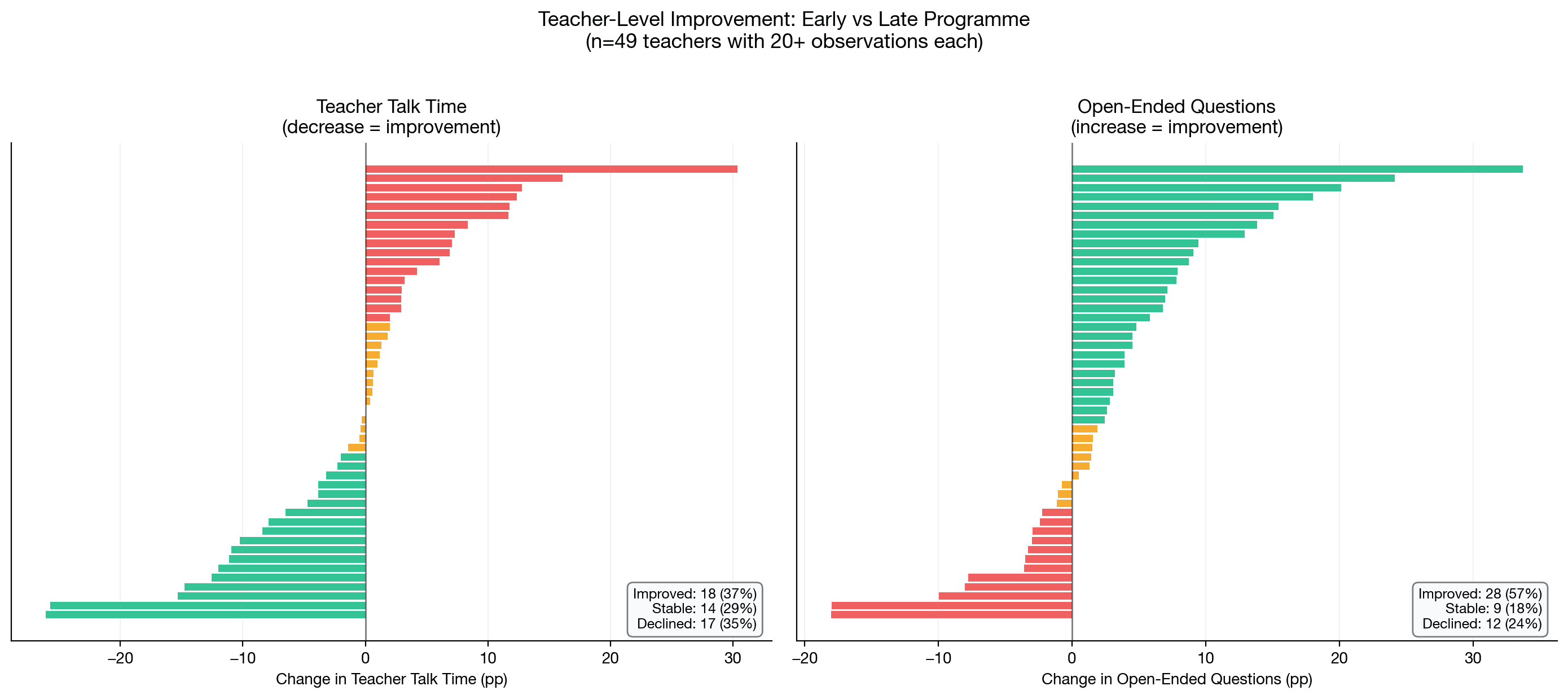
Teacher Improvement Over Time
Among 49 teachers with 20+ observations each, the data shows clear improvement patterns. 57% of teachers increased their use of open-ended questions, and 37% reduced teacher talk time — with stronger effects for those who received more AI feedback.
Teacher-Level Improvement: Early vs Late Programme (n=49)
Dosage Effect: Does More AI Feedback Lead to Better Practice?
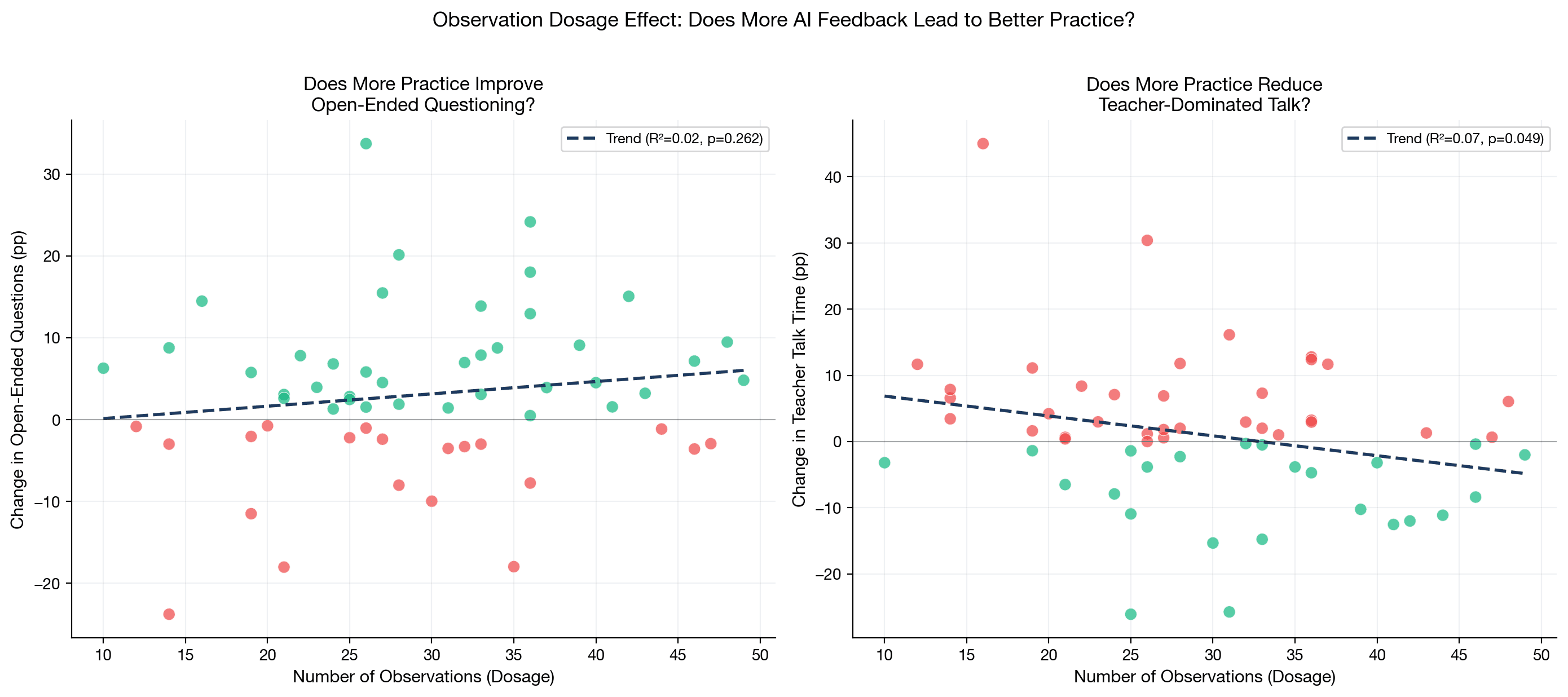
Teachers who received more AI observations showed a positive trend in open-ended questioning (p=0.26) and a statistically significant reduction in teacher talk time (p=0.049).
Balochistan Evidence Base
From baseline diagnostics to AI-vs-human analysis, these reports document Taleemabad's work in Pakistan's most challenging province.
Chapter 06
Punjab
Scaling Through Government Partnerships
232
Schools on SchoolPilot
The Operating System for School Management
Punjab is home to Pakistan's largest public education system — over 52,000 schools serving millions of children. The Punjab Ministry of Education has committed to deploying Taleemabad in 6,000 schools, making this the most ambitious EdTech partnership in Pakistan's history.
SchoolPilot is the platform powering this transformation. It provides real-time school management, attendance tracking, student assessment, and task completion monitoring — giving administrators and partners a live view of what's happening across hundreds of schools.
SchoolPilot Live Dashboard
Data as of 2026-02-05
Schools
Teachers
Students
12K
Attendance Records
7K
Student Scores
2K
Task Completions
Implementation Partners
Moawin Foundation
77% of total schools
Akhuwat Foundation
21% of total schools
Teachers Co-Designing WhatsApp AI Tools
As part of EdTech Hub's Teachers-in-the-Lead Sandboxes, Taleemabad worked with Moawin Foundation teachers in Punjab to co-design Lesson Genie — a bilingual WhatsApp AI chatbot that generates grade-specific lesson plans adapted to available teaching time. Teachers were not end-users; they were co-designers from inception.
Teachers juggling multiple grades in one room needed something accessible and fast. WhatsApp was the answer — no app downloads, works in rural areas with low data, and already on every teacher's phone.
Read the full article on EdTech HubUpcoming Research Studies
Rawalpindi Longitudinal Study
Research Question: Can we enable government-based coaches (AEOs) with AI tools to improve teacher practice at scale?
Multi-year study tracking student learning outcomes and teacher development across 260 Rawalpindi schools to establish long-term impact evidence.
Punjab Pilot Design
Randomized controlled trial designed to rigorously evaluate the impact of Taleemabad's integrated platform on student learning outcomes across Punjab province public schools.
Chapter 07
Rumi
AI-Powered Coaching Revolution
1,870
Teachers on Rumi
Rumi is an AI coaching platform that provides real-time, personalized feedback to teachers via WhatsApp. Launched in 2025, it is already reaching teachers across 6 countries — delivering the kind of continuous instructional support that was previously impossible to scale.
No app downloads. No expensive hardware. Just a WhatsApp message away from better teaching.
Try Rumi Now2K
Teachers Using Rumi
163
Schools Engaged
5K
Audio Coaching Sessions
2K
AI-Generated Lesson Plans
22
Avg Messages per Conversation
1K
New Teachers This Month
Global Reach
Engagement Metrics
2K
Total Conversations
avg 22.2 messages each
5K
Audio Coaching Sessions
382 unique users
2K
Lesson Plans Created
AI-generated, curriculum-aligned
Reading Assessment
108
Students Assessed
via Rumi audio reading tool
69.4%
Reading at Grade Level
on-track across all grades
84
Avg Words Per Minute
WCPM across assessed students
1K
new teachers joined in the last 30 days
That's roughly 37 new teachers every single day
Three Core Capabilities
Audio Analysis
AI listens to classroom audio recordings and provides real-time feedback on teaching practices, question types, and student engagement.
Lesson Planning
AI-generated lesson plans tailored to curriculum standards, grade level, and subject. Teachers get ready-to-use plans in seconds.
WhatsApp Integration
Teachers interact through WhatsApp — no app download needed. Coaching meets teachers where they already are, on the tool they already use.
Data as of 2026-02-05
Chapter 08
Taleemabad Animation Series
Reaching 10 Million+ Students Through Every Screen
10M+
Students Reached
Not every child has a smartphone. Not every school has internet. So we built a learning system that meets children where they are — through an app, on television, and over a phone call.
The Taleemabad Animation Series brings curriculum-aligned, joyful learning content to millions of students across Pakistan through multiple delivery channels — ensuring no child is left behind because of the device they have or the connectivity they lack.
Taleemabad App
1M+ Downloads
Interactive lessons, gamified learning, Urdu & English content
Taleemabad on TV
8M+ Viewers
Partnership with PTV — bringing quality content to every screen in Pakistan

Meet Pinky & Jojo
Our beloved mascots take children on adventures through learning! Pinky, a curious young girl with pink hair, and her companion Jojo, a boy who loves soccer, make education exciting and relatable for millions of Pakistani children — turning every lesson into an adventure.
Watch Taleemabad AnimationsSample episode from the Taleemabad Animation Series
From Classrooms to Countries
What began in low-cost private schools produced a gold-standard RCT showing 0.28 SD learning gains across Islamabad's 422 public schools. In Balochistan, AI observation revealed the student voice crisis. In Punjab, government partnerships are scaling the model. And through Rumi, AI coaching now reaches teachers across 6 countries.
0.28 SD
Effect Size (Gold-Standard RCT)
1,870
Teachers on Rumi Globally
6
Countries & Growing
The evidence is clear. The model works. What remains is the question of scale — and that requires partners who believe that every child deserves a great teacher.
Join the Mission
Partner With Us
26 million children in Pakistan are out of school. We have the evidence. We have the technology. We need partners who share the urgency.
Download Impact Report
Get our comprehensive evidence package with RCT results, cost analysis, and implementation data.
Download PDFSchedule a Briefing
A 30-minute session with our team to walk through evidence, methodology, and partnership opportunities.
Book a MeetingExplore Partnership
Join us in reaching the next 500,000 students. We are looking for partners who believe in evidence-driven impact.
Get in Touchsabeena@taleemabad.com · taleemabad.com